Loading...
About SIP

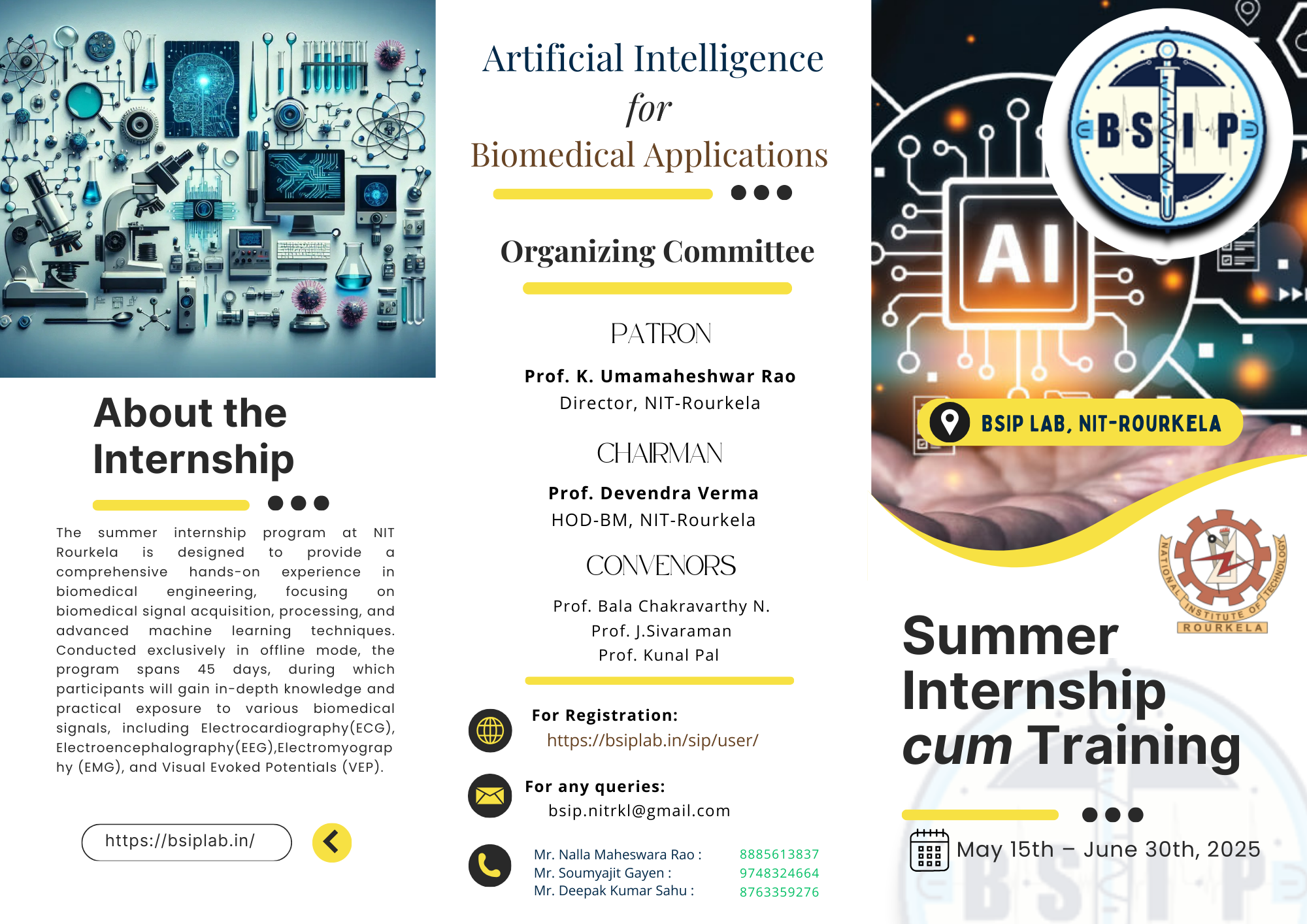
The summer internship program at NIT Rourkela is designed to provide a comprehensive hands-on experience in biomedical engineering, focusing on biomedical signal acquisition, processing, and advanced machine learning techniques. Conducted exclusively in offline mode, the program spans 45 days, during which participants will gain in-depth knowledge and practical exposure to various biomedical signals, including Electrocardiography (ECG), Electroencephalography (EEG), Electromyography (EMG), and Visual Evoked Potentials (VEP). The training will cover essential topics such as acquisition of biomedical signals, including ECG for cardiac analysis, EEG for brain activity monitoring, EMG for muscle function assessment, and VEP for visual system evaluation. Additionally, students will learn data processing techniques for biomedical signals and images, enabling them to extract meaningful insights from complex datasets. The program also integrates machine learning and deep learning methodologies, empowering participants to develop AI-driven solutions for biomedical applications. A key highlight of the internship is a competitive challenge, where students will apply their acquired skills to develop and optimize machine learning models for biomedical applications. This competition will encourage innovation and problem-solving, with awards for the best model design.

Register / check status
Summer Internship Cum Training Program

About the Program

The summer internship program at NIT Rourkela is designed to provide a comprehensive hands-on experience in biomedical engineering, focusing on biomedical signal acquisition, processing, and advanced machine learning techniques. Conducted exclusively in offline mode, the program spans 45 days, during which participants will gain in-depth knowledge and practical exposure to various biomedical signals, including Electrocardiography (ECG), Electroencephalography (EEG), Electromyography (EMG), and Visual Evoked Potentials (VEP). The training will cover essential topics such as acquisition of biomedical signals, including ECG for cardiac analysis, EEG for brain activity monitoring, EMG for muscle function assessment, and VEP for visual system evaluation. Additionally, students will learn data processing techniques for biomedical signals and images, enabling them to extract meaningful insights from complex datasets. The program also integrates machine learning and deep learning methodologies, empowering participants to develop AI-driven solutions for biomedical applications. A key highlight of the internship is a competitive challenge, where students will apply their acquired skills to develop and optimize machine learning models for biomedical applications. This competition will encourage innovation and problem-solving, with awards for the best model design.

Registration Details

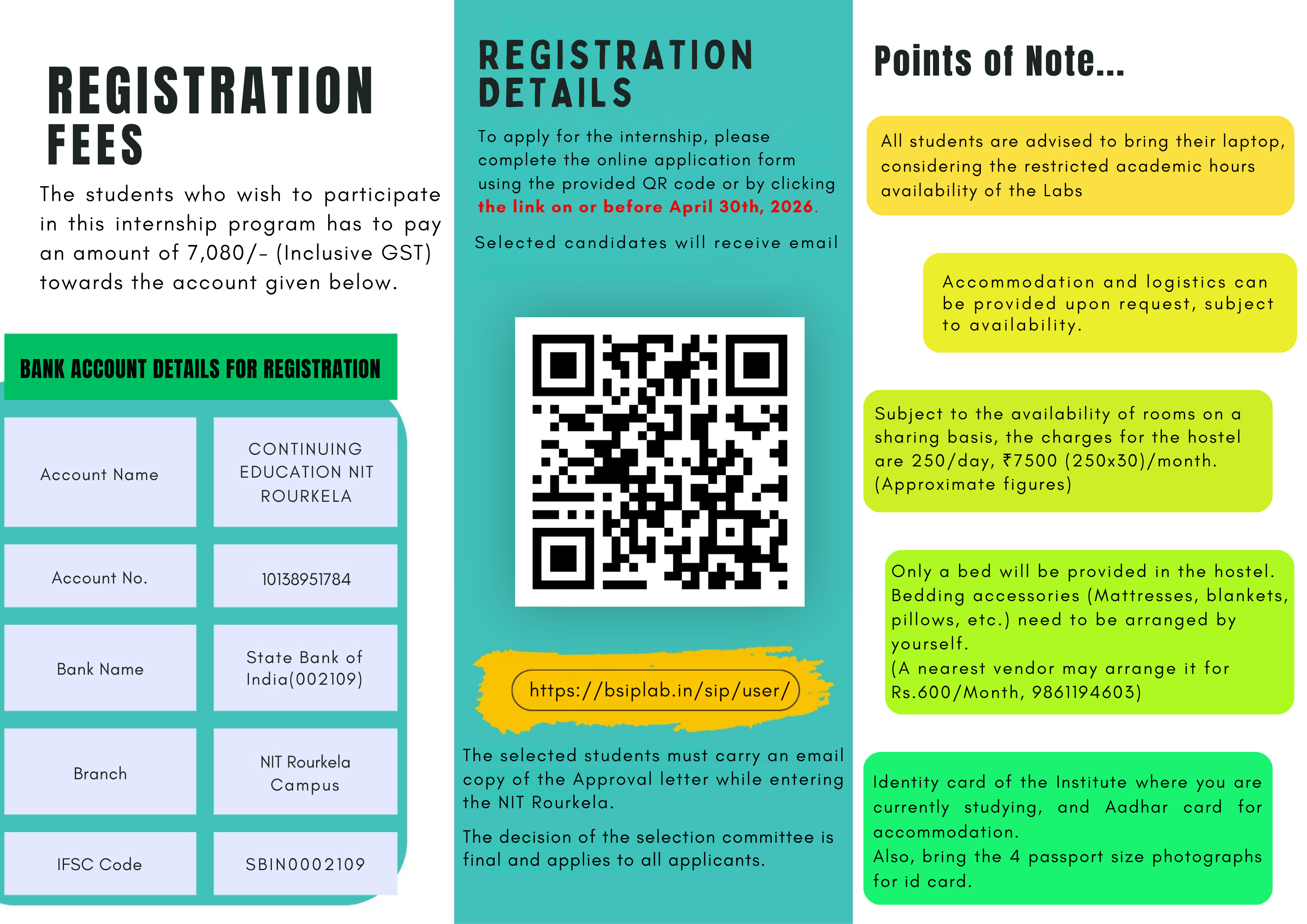
The students who wish to participate in this internship program has to pay an amount of 9,440/- (Inclusive GST) towards the account given below

BANK ACCOUNT DETAILS FOR REGISTRATION
Account Name: CONTINUING EDUCATION
NIT ROURKELA
Account No: 10138951784
Bank Name State Bank of India(002109)
Branch: NIT Rourkela Campus
IFSC Code SBIN0002109

To apply for the internship, please complete the online application form using the provided QR code or by clicking the link bsiplab.in/sip/user/ on or before April 25th , 2026. Selected candidates will receive email notifications on April 30th , 2026. The selected students must carry an email copy of the Approval letter while entering the NIT Rourkela. The decision of the selection committee is final and applies to all applicants.

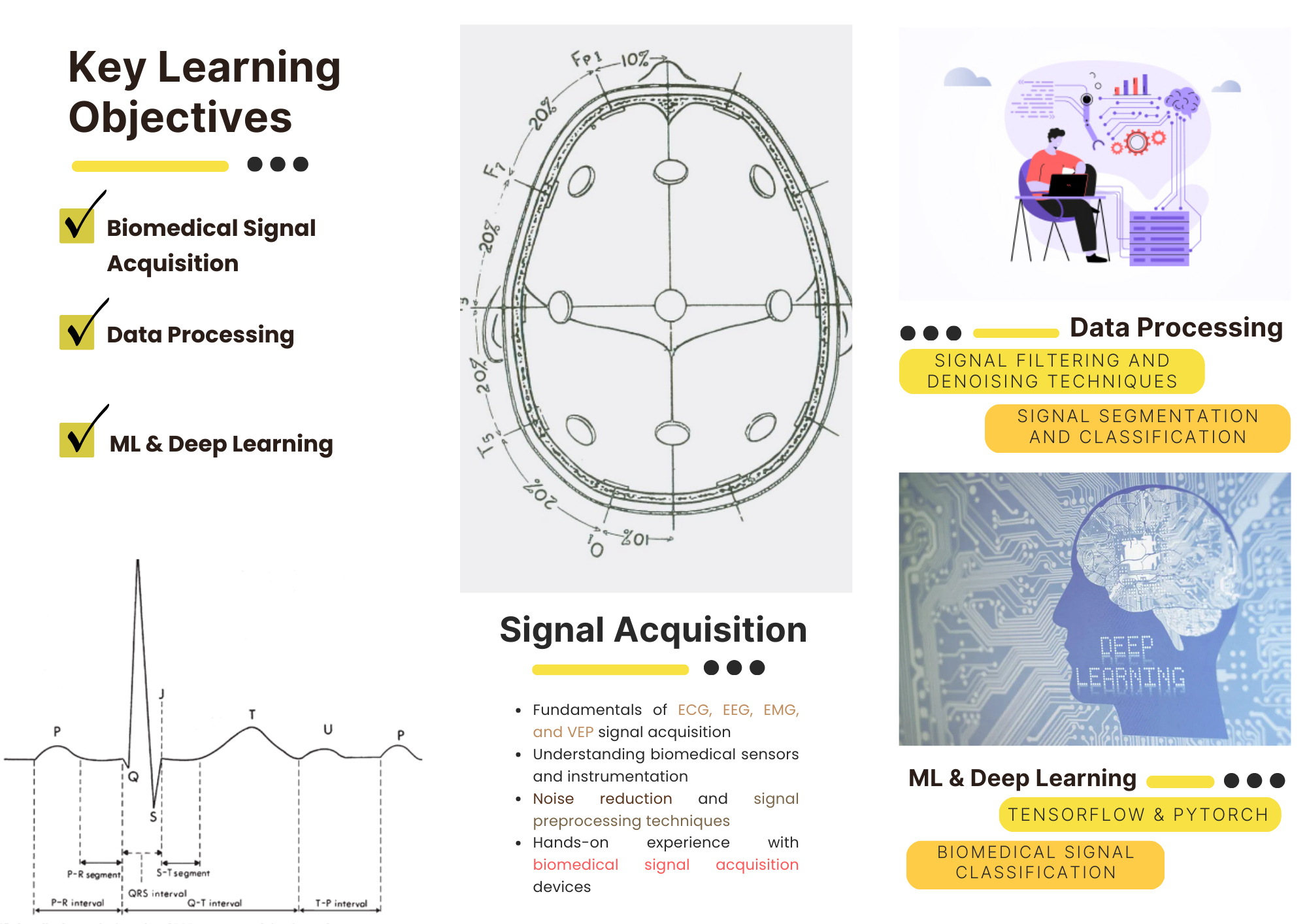
Learning Objectives

Biomedical Signal Acquisition

  • Fundamentals of ECG, EEG, EMG, and VEP signal acquisition
  • Understanding biomedical sensors and instrumentation
  • Noise reduction and signal preprocessing techniques
  • Hands-on experience with biomedical signal acquisition devices

Data Processing of Biomedical Signals and Images

  • Signal filtering and denoising techniques
  • Feature extraction from ECG, EEG, EMG, and VEP signals
  • Image preprocessing for medical imaging (CT, MRI, X-ray)
  • Time-frequency analysis and spectral analysis of signals
  • Signal segmentation and classification

Machine Learning & Deep Learning for Biomedical Applications

  • Supervised and unsupervised learning for biomedical data
  • Deep learning models (CNN, RNN, LSTM) for signal and image analysis
  • AI-driven diagnosis and disease prediction
  • Implementing neural networks for biomedical signal classification
  • Hands-on training in Python using TensorFlow & PyTorch
  • Model evaluation and optimization for medical applications

Course Outcomes

  • Comprehensive understanding of the theoretical concepts on medical signal and image processing
  • Hands-on experiment on medical devices including ECG, EMG, VEP, and BERA
  • Theoretical aspects of AI-based techniques
  • Implementation of AI techniques using popular software tools and programming languages
  • Clinical integration of AI in medical signal and image processing
About the Institution

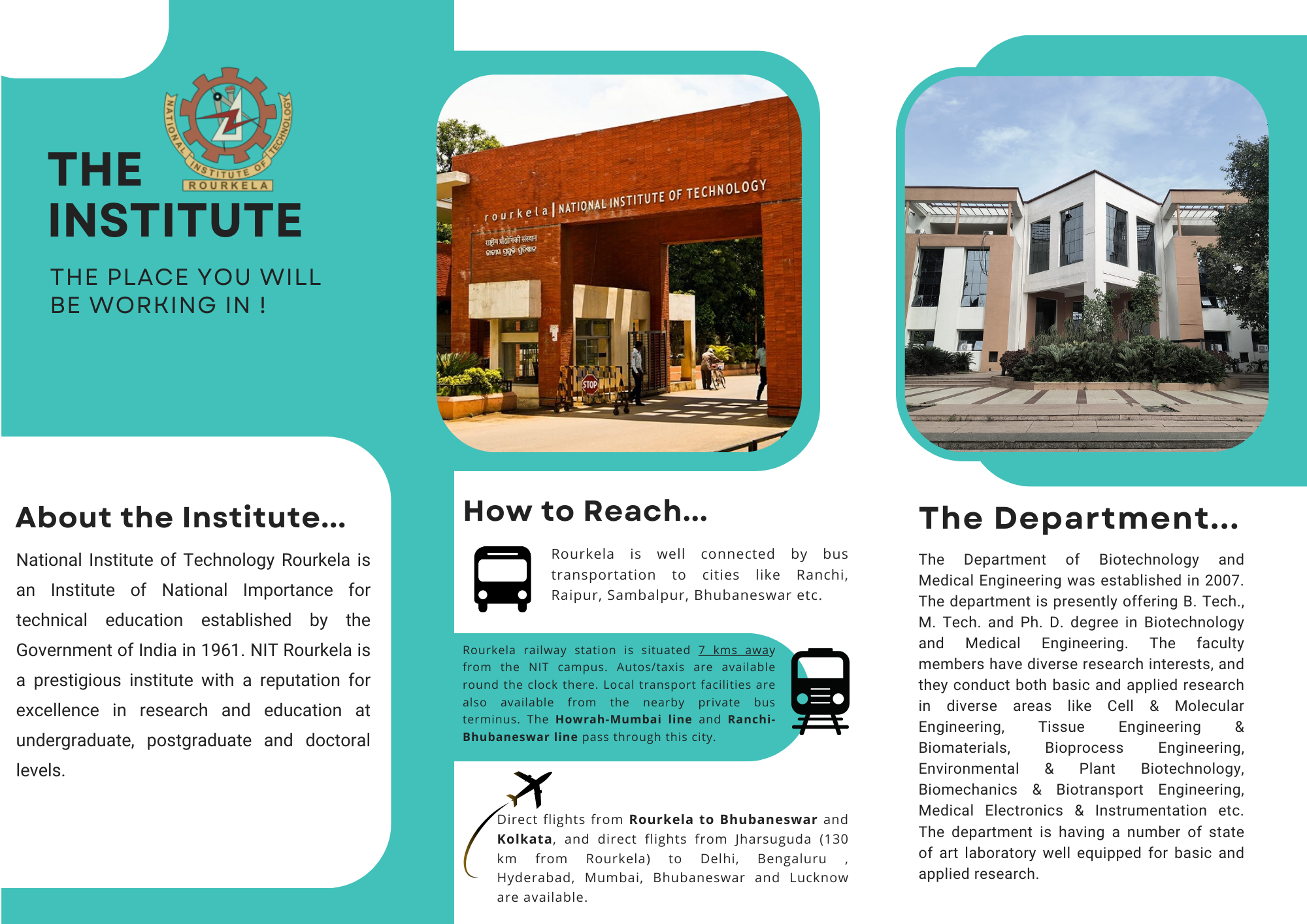
National Institute of Technology Rourkela is an Institute of National Importance for technical education established by the Government of India. NIT Rourkela is a prestigious institute with a reputation for excellence in research and education at undergraduate, postgraduate and doctoral levels.

Contact Information

Prof. Bala Chakravarthy N :[email protected]

Prof. Sivaraman J : [email protected]

Prof. K. Pal : [email protected]

Email: [email protected]

Department of Biotechnology & Medical Engineering, National Institute of Technology Rourkela, Odisha 769008, India.

Student Co-ordinators

Mr. Nalla Maheswara rao : 8885613837

Mr. Soumyajit Gayen : 9748324664

Mr. Deepka Kumar Sahu : 8763359276

Modules
Bio Medical Signal Acquisition
  • Fundamentals of ECG, EEG, EMG, and VEP signal acquisition
  • Understanding biomedical sensors and instrumentation
  • Noise reduction and signal preprocessing techniques
  • Hands-on experience with biomedical signal acquisition devices
Data Processing of Biomedical Signal and Images
  • Signal filtering and denoising techniques
  • Feature extraction from ECG, EEG, EMG, and VEP signals
  • Image preprocessing for medical imaging (CT, MRI, X-ray)
  • Time-frequency analysis and spectral analysis of signals
  • Signal segmentation and classification
ML & DL for Biomedical Applications
  • Supervised and unsupervised learning for biomedical data
  • Deep learning models (CNN, RNN, LSTM) for signal and image analysis
  • AI-driven diagnosis and disease prediction
  • Implementing neural networks for biomedical signal classification
  • Hands-on training in Python using TensorFlow & PyTorch
  • Model evaluation and optimization for medical applications